How it works
A tokenized stock pays you by quietly changing a number on the token. No transfer arrives, so no wallet, explorer or tracker records that you were paid. This page shows what that looks like, and what you get here instead.
First, what actually happens when you are paid
Every token has a multiplier attached to it. Your balance is the raw number of tokens you own multiplied by that figure. When the issuer receives the dividend from the company, it raises the multiplier, and every holder's balance rises at that instant.
On 8 Aug 2026, AAPLx moved from 1.002664208 to 1.003269013. Someone holding 100 of them went from 100.266421 to 100.326901 — paid 0.060480 AAPLx — and nothing appeared in their wallet history, because nothing was sent.
That is why this exists. The payment is real and it is recorded on Solana, but it is recorded on the token, not in your wallet, and no one was joining the two.
Paste an address, get a statement
Type or paste any Solana address. You do not connect anything, you do not sign anything, and it works for an address you do not own — so you can check this page against a wallet you already know.
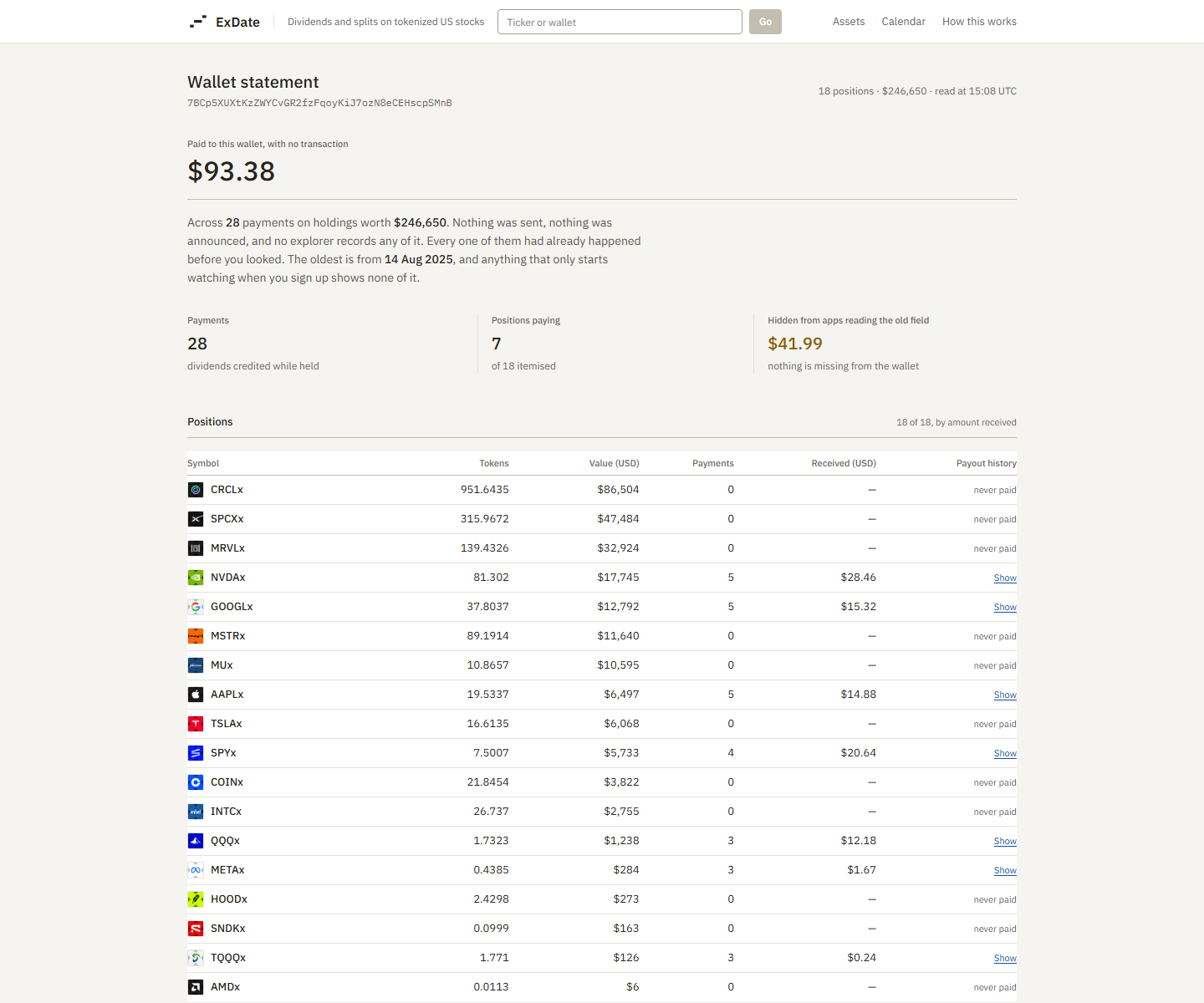
Open any row to see where the figure came from
Nothing here asks you to take a number on trust. Every position opens into the payments behind it: the date, the multiplier before and after, the tokens that appeared, and what they were worth.
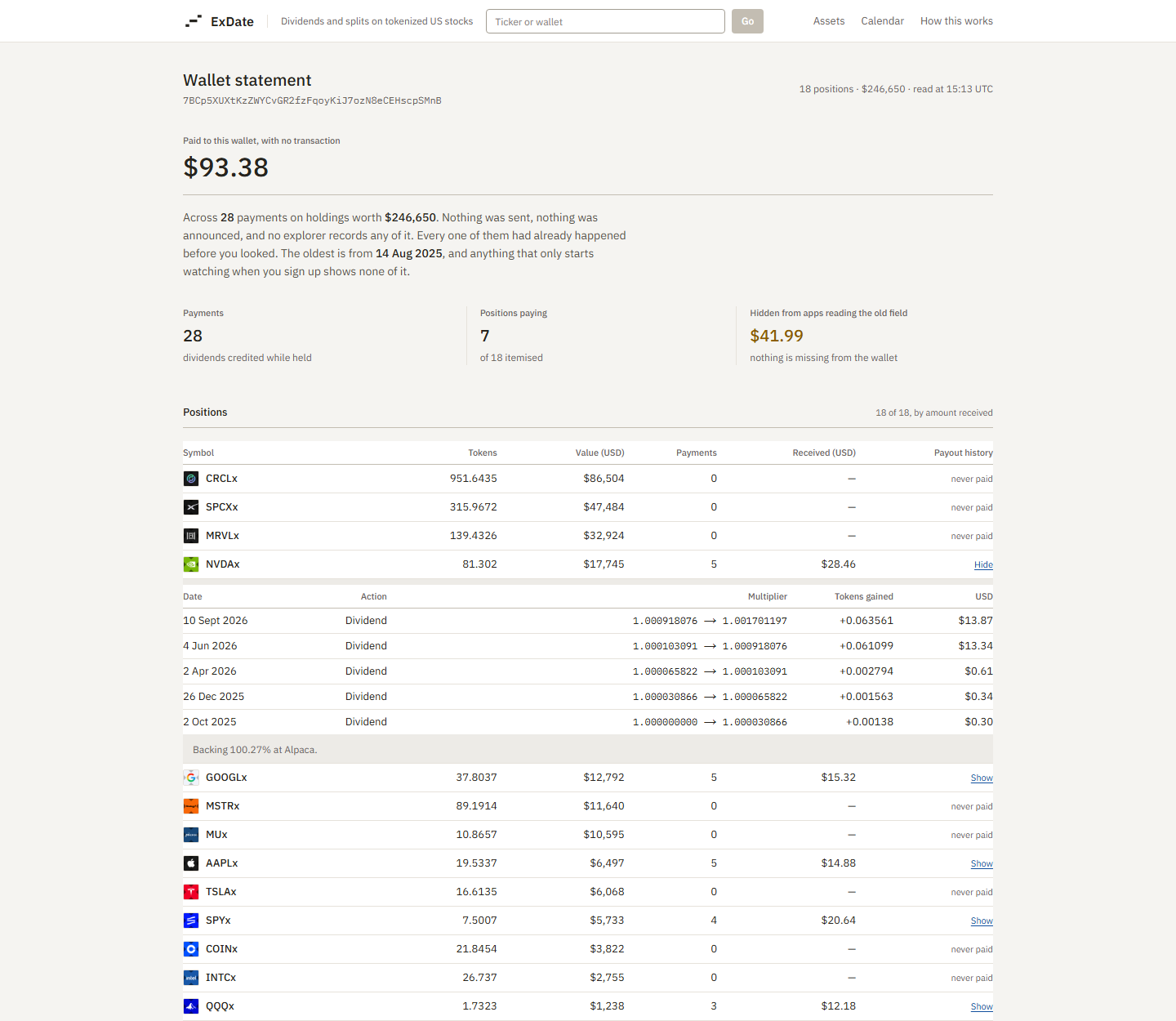
You can link straight to one: add ?show=NVDAx to a wallet address and that position opens on load.
Or look up a stock instead of a wallet
Type a ticker — AAPL, PFE, NVDA — and see what that stock has paid its holders since it was tokenized, what the next payment is, how much US tax is withheld from it, and whether the tokens are actually backed by shares held in custody.
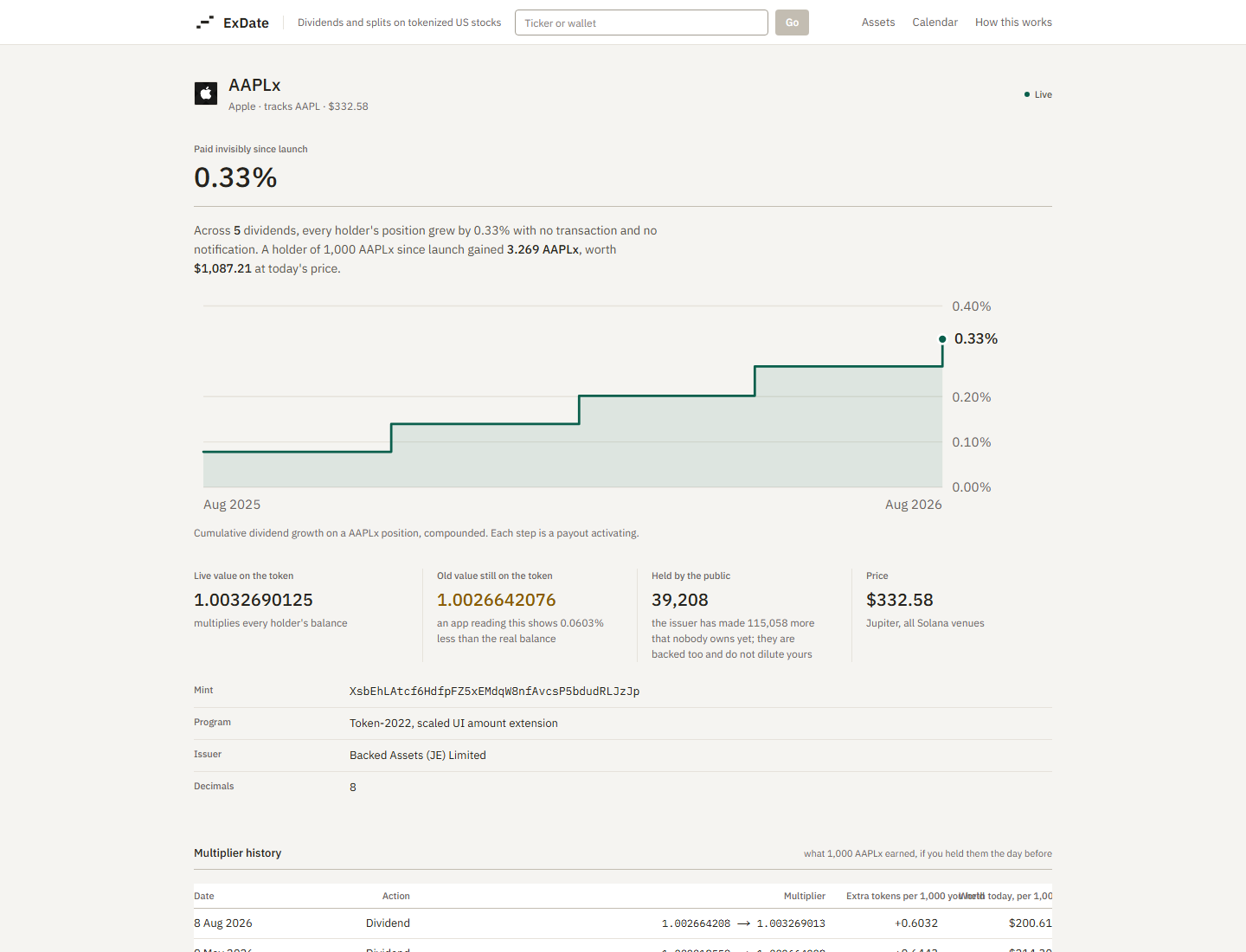
And see what is coming
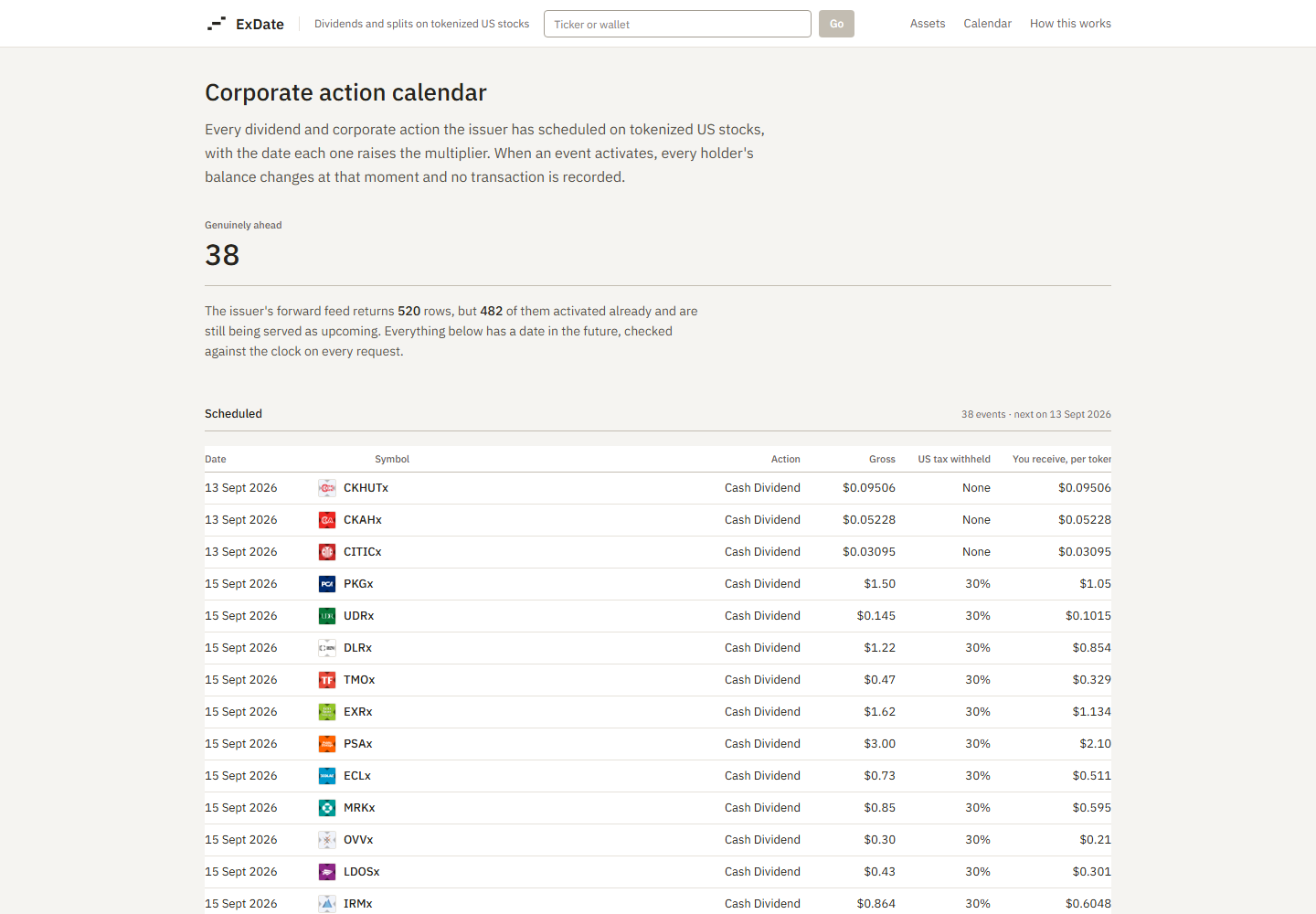
The issuer stages each payment about a day before it takes effect, so it can be known in advance. The calendar shows every one still to come, with the tax withheld and what you receive per token.
What it costs, and what it can do to your wallet
- Price
- Free. There is no account.
- What it asks for
- An address or a ticker. Nothing else.
- What it can do
- Read public information. It cannot move, spend or touch your tokens.
- What it stores
- Nothing. Addresses are read and not kept.
- How current it is
- Your wallet is read from Solana at the moment you ask, not from a cache.
Try it
Examples: AAPL, PYPL, NFLX, PFE
Safe to paste. This site only reads public information. It never asks you to connect a wallet or sign anything, and it cannot move your tokens.
Bought on an exchange? Your tokens sit in the exchange's own wallet, so a wallet lookup will not find them. Type the ticker instead to see what that stock paid per token.
Every figure on this site is read from Solana and from the issuer's public records, and the total stands at $11,984,608 across 628 payments. If you want to check how each one is derived, which sources produced it, what it deliberately excludes and what we got wrong along the way, that is written up in full on Method and sources.